
Read time: 2 minutes
A recent Four Corners investigation has put adult ADHD diagnosis rates in Australia under the microscope, and what it found is harder to summarise than a simple overdiagnosis story. Working with data experts at UNSW Sydney, the program analysed prescription fill rates for ADHD medications, currently the only available proxy for diagnosis given there is no national register, and the variation by postcode is striking.
What's showing up in practice looks different depending on the patient. Some arrive with a diagnosis already in hand, obtained through a telehealth service, sometimes without what most clinicians would consider a thorough assessment. Others have been living with significant symptoms for years, never assessed, never treated. One patient is asking you to renew a script for a diagnosis you had no part in making. Another is describing something that has never been named. Both are common. Both require a different response.
In parts of Australia, an estimated 90% of people with ADHD are not being treated, missing out on treatment that could make a significant difference to their lives.
The clinical conversation worth having right now isn't about validating or challenging an existing diagnosis. It's about what a thorough assessment actually involves, and why it matters. That means taking a full history, ruling out other explanations for the symptoms, and not rushing. For patients who've had a quick telehealth consultation, that's worth naming directly: not as a challenge to their experience, but as a way of making sure nothing else is being missed. Depression and anxiety can present in ways that look a lot like ADHD, and if they're mislabelled, they go untreated.
The accepted adult prevalence of ADHD is around 3%. In parts of Fremantle, Western Australia, up to 8% of women under 44 have received a diagnosis, a figure that has emerged rapidly over just five or six years. Marrickville in Sydney and Brunswick in Melbourne also show elevated rates.
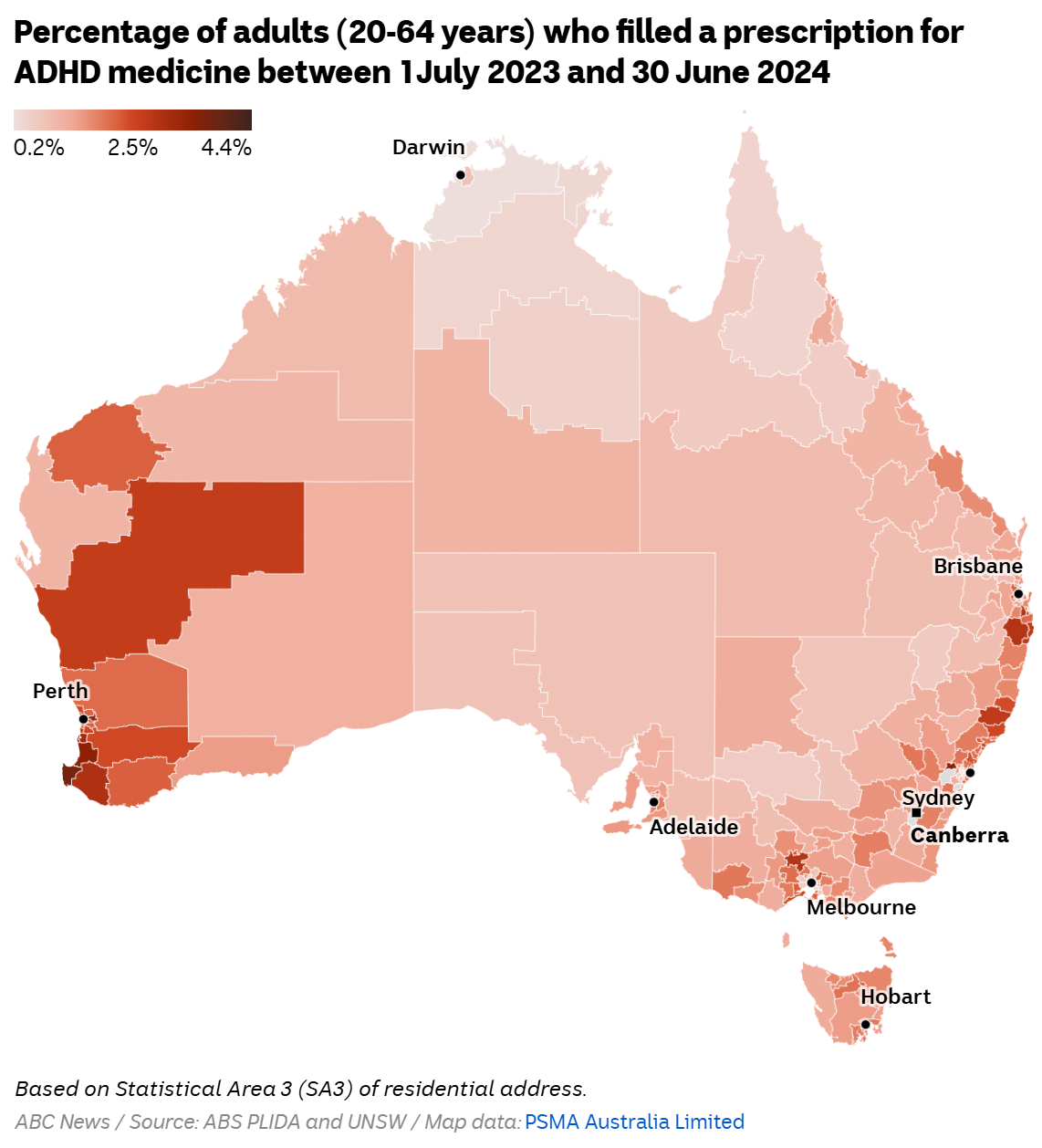
It is hard to explain why rates are so high in these areas. Social influencers have raised awareness, and it seems some telehealth psychiatrists are quick to write a script without a proper assessment. But the data cuts the other way too. In parts of Southwest Sydney, an estimated 90% of people with ADHD are not being treated, missing out on treatment that could make a significant difference to their lives. Overdiagnosis in one suburb and significant underdiagnosis in another are both failures of the same system.
On the other hand, there are many parts of Australia where diagnostic rates are so low that people with genuine ADHD are missing out on treatment that could make a significant difference to their lives. There are parts of Southwest Sydney where 90% of people with ADHD are not being treated. Overdiagnosis in one suburb and significant underdiagnosis in another are both failures of the same system.
Proper adult ADHD assessment is time-consuming and, without public sector options, expensive. There are no shortcuts that serve the patient well. The picture may shift as more GPs are trained to diagnose and prescribe. Queensland GPs can already do so without specialist referral, though the safety and effectiveness of that model is yet to be formally evaluated. What's clear is that the right diagnosis, made carefully and thoroughly, is the thing most likely to change the outcome for the person sitting across from you.
References
References Four Corners. ADHD diagnosis rates in adults: Australia. ABC News, April 2026. https://www.abc.net.au/news/2026-04-20/adhd-diagnosis-rates-adults-australia-data-four-corners/106557646
What should Practice Connect cover next?
"*" indicates required fields
